Friday, April 26, 2013
The Interpersonal Rat Race
I'd be lying if I said this wasn't, well, personal in some way, and that I'm not being defensive at all. But the truth is, the way we view our progress in our personal lives is very much affected by what we see others around us doing. Unless we are completely passionate or completely apathetic about something, we tend to grade ourselves on a curve.
Facebook has made us all too aware of that curve, however small a sample group that happens to be. Every time we log on we get a veritable progress report of other people's lives, which in turn informs our own sense of progress. I'm not saying this is a good thing. But I also don't think it's an entirely new phenomenon.
However, I do think there's this illusion today that all 20-somethings don't want to settle down. As if it is some confirmed choice they are making. I suppose, for some people, that may be true. But for the majority of us, we generally don't have the luxury of happening upon a good life partner while we are struggling to find work, to keep work, and to basically feed ourselves and keep a roof over our heads. I have nothing against facing these struggles with someone I trust next to me. It's finding someone to trust that becomes the problem. When your day is filled with your job, job hunting, staying healthy, and staying sane as you stumble around (which, let's face it, is basically what your 20's are), unless you stumble right into the right person, your mostly stumbling around alone, hoping you can find your feet somewhere that makes you happy. Because when you do what makes you happy, and are happy yourself, it generally increases your chances of finding someone who also makes you happy.
So, no, I don't believe that there is some mythical "One" out there that people should just be waiting to stumble into like some trite romantic comedy. But I think there are two ingredients to a lasting partnership, and both need to be there for it to really work: 1) right person and 2) right time. People tend to forget about the latter. There are several reasons why the timing could be wrong. Maybe you aren't emotionally available, maybe you're moving, or maybe you're already too far away. True, there's a fine line between reasons and excuses. But even making illegitimate excuses itself is a sign that one or both of the needed ingredients are missing.
Meanwhile, we see friends, and colleagues, and that-person-we-really-don't-know-but-for-someone-reason-we're-facebook-friends getting engaged, married, buying homes and making babies at an alarming rate. And, suddenly, it seems as we are moving in slow motion, stuck in existential molasses and hyper aware of our mortality for the first time. As if there is something wrong with us for not keeping up with this curve, this interpersonal rat race for the partner, the family and the home. But the truth is people do things at their own pace, in their own time, and always have. The people that force themselves into things for the wrong reasons, because of their own doubts or insecurities, tend to eventually wake up one day living a life they never wanted.
Once we realize this, we also realize that grading our interpersonal relationships on a curve is flawed and ultimately dangerous to our own development. In the end, the only way to feel as if you aren't moving in slow motion is to keep moving yourself, without stopping to compare yourself to other people. Move toward something you want. Making moves towards something you think you should want is just another form of lying to yourself.
Thursday, March 21, 2013
What I Want
What do I want? I’m just getting older. And I want to see more of the world. I want to climb mountains and catch the Sun’s light refracting and exploding across our atmosphere. I want to see the horizon flat in front of me on an abandoned road, the dust of desert whipping past my wheels.
I want to see the fog of the Milky Way’s profile with the naked eye and grasp the earth as I imagine the speed we move in through the universe, breakneck and beautiful. I want to run across Bolivia's Uyuni salt flats, marveling at the perfect reflection of sky beneath me. Stomping across the sheen of my own feet.
I want to travel across the ocean and sample every brew in every small tavern, take in that warmth, and connect. Connect with someone, anyone, and feel that second of recognition. We get each other, and that makes this worth it. This. This stool, my hand, my lungs, my limbs. They’re small but the scale doesn’t matter because the grandiose wonder I feel right now is straight up Dr. Whovian.
If I had a cabin, I’d cut up peasant bread and fresh tomatoes on a wooden butcher block. Smell that high altitude and self-inflicted solitude, and timber in a stone fireplace. I’m pretty simple. I’m pretty trite. I write so I can grasp these things in my mind. Grasp that place between adventure and peace. To take it all in and when I revert to dust, leave my subtle prints, like dead star whose light continues to travel through the fabric of space.
That’s what I want.
Wednesday, February 20, 2013
Partisanship in the 21st Century
Growing up with a red family in a blue state with blue friends, I did what anyone would do when those she respected were at odds: I disenthralled myself. For many years, that meant political apathy. I dismissed politics like a disillusioned practitioner dismisses religion. Politics were divisive, cruel, and most often without point or resolution. It was only years later that I realized it wasn’t politics I hated. Politics is simply the science of government, the affairs of a state. For centuries, we’ve viewed it through the lens of democracy.
So, then, what did I hate? Well, you know that feeling you get when all you want cable for is to watch Shark Week and Breaking Bad, but you have to pay for atrocities like TLC and Bravo to get it? That’s sort of how I felt about politics: like a frustrated, cable-bundled consumer. What’s worse, I knew everyone around me hated it too. But one conflicting viewpoint into a conversation and they were singing the bundling song and dance. Suddenly, because I liked watching shark documentaries (I mean who doesn’t?) I also must like Bridezillas because, after all, it’s part of the bundle.
In a country that prides itself on democracy, the supposed lens of politics in the 21st Century, we all seem to be complacently running on an alarmingly small number of choices based on the fear that finding new ones will only result in the least desired outcome gaining ultimate power. We are stuck in a holding pattern that has forced us to bundle issues that have little logical relation to one another. As a nation, we’ve divided ourselves into teams like some bureaucratic game of capture the flag. And it’s only getting worse.
In his post-election concession speech in 2012, libertarian candidate Gary Johnson stated, “A wasted vote is voting for somebody you don’t believe in and there were a lot of wasted votes tonight.” Whatever you think of Johnson or his affiliations, the sentiment here expresses a missing piece in the heart of a democratic society. We’ve started to vote against the person we loathe rather than vote for the one we believe in. It has turned our participation in public affairs into a negative right, one based one the absence of real choice.
Nevertheless, the polarization appears to be increasing. With one party hoping the other goes the way of the Whigs, and the other clamoring to redefine itself into another bundle combo. The result is either a one party system, or another two party standstill. It changes nothing.
There’s a perception that red is limited government and blue is big government. There’s also a perception that we can whittle every public policy view down to a couple primary colors so I don’t know why I find this surprising. In any case, the assumption overlooks the fact that limited or big government is circumstantial, dependent on priorities. And like everything else in bipartisan America, priorities come bundled.
Some hope--and others dread-- that libertarians will introduce a third party to the system. But in my experience, it’s generally treated like an ideology more than a party. And, once again, when opinions clash, many are quick to assign that ideology red or blue colors, if not dismiss it entirely. Perhaps all this is easier on us, this dichromatic, paint-by-the-numbers approach to a citizen’s participation in public affairs and discourse. We vote for candidates primarily based on what team they're on, and yet we couldn’t be more displeased with our representatives. Perhaps this is justified with the knowledge that our color is on the side of the good and the righteous, even if it is outrageously prone to hyperbole. But how far are we willing to oversimplify policy and dilute our voice for the sake of a lesser evil? When does this bundling system itself become the worst outcome?
This is not about what stance I take on public policy issues. My stances are wide, varied, and open to growth based on new information and perspectives, all informed through the lens of our democracy. This is about having a real choice to hold views free from the platforms they’ve been locked into. If only to dispel party prejudice and return civility and efficiency to political discourse amongst ourselves: color me disenthralled.
So, then, what did I hate? Well, you know that feeling you get when all you want cable for is to watch Shark Week and Breaking Bad, but you have to pay for atrocities like TLC and Bravo to get it? That’s sort of how I felt about politics: like a frustrated, cable-bundled consumer. What’s worse, I knew everyone around me hated it too. But one conflicting viewpoint into a conversation and they were singing the bundling song and dance. Suddenly, because I liked watching shark documentaries (I mean who doesn’t?) I also must like Bridezillas because, after all, it’s part of the bundle.
![]() |
| This makes total sense |
In a country that prides itself on democracy, the supposed lens of politics in the 21st Century, we all seem to be complacently running on an alarmingly small number of choices based on the fear that finding new ones will only result in the least desired outcome gaining ultimate power. We are stuck in a holding pattern that has forced us to bundle issues that have little logical relation to one another. As a nation, we’ve divided ourselves into teams like some bureaucratic game of capture the flag. And it’s only getting worse.
In his post-election concession speech in 2012, libertarian candidate Gary Johnson stated, “A wasted vote is voting for somebody you don’t believe in and there were a lot of wasted votes tonight.” Whatever you think of Johnson or his affiliations, the sentiment here expresses a missing piece in the heart of a democratic society. We’ve started to vote against the person we loathe rather than vote for the one we believe in. It has turned our participation in public affairs into a negative right, one based one the absence of real choice.
Nevertheless, the polarization appears to be increasing. With one party hoping the other goes the way of the Whigs, and the other clamoring to redefine itself into another bundle combo. The result is either a one party system, or another two party standstill. It changes nothing.
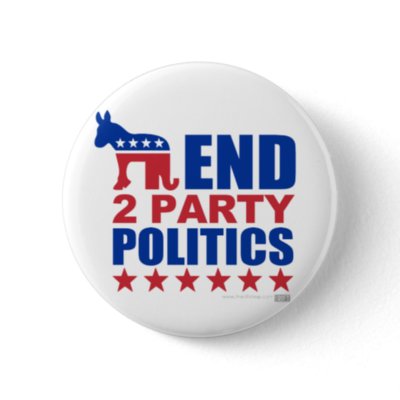
| Uh, what? Credit: zazzle.com |
There’s a perception that red is limited government and blue is big government. There’s also a perception that we can whittle every public policy view down to a couple primary colors so I don’t know why I find this surprising. In any case, the assumption overlooks the fact that limited or big government is circumstantial, dependent on priorities. And like everything else in bipartisan America, priorities come bundled.
Some hope--and others dread-- that libertarians will introduce a third party to the system. But in my experience, it’s generally treated like an ideology more than a party. And, once again, when opinions clash, many are quick to assign that ideology red or blue colors, if not dismiss it entirely. Perhaps all this is easier on us, this dichromatic, paint-by-the-numbers approach to a citizen’s participation in public affairs and discourse. We vote for candidates primarily based on what team they're on, and yet we couldn’t be more displeased with our representatives. Perhaps this is justified with the knowledge that our color is on the side of the good and the righteous, even if it is outrageously prone to hyperbole. But how far are we willing to oversimplify policy and dilute our voice for the sake of a lesser evil? When does this bundling system itself become the worst outcome?
This is not about what stance I take on public policy issues. My stances are wide, varied, and open to growth based on new information and perspectives, all informed through the lens of our democracy. This is about having a real choice to hold views free from the platforms they’ve been locked into. If only to dispel party prejudice and return civility and efficiency to political discourse amongst ourselves: color me disenthralled.
Monday, February 11, 2013
Galactic Perspective
The Earth, rotates at over 1,000 miles per hour. This is your speed on the ground. The Earth is moving around the sun at over 67,000 miles per hour. We sit on the edge of the milky way galaxy, in a solar system moving over 400,000 miles per hour around the galactic core. It takes takes roughly 200-250 million years for our solar system to orbit the galactic center once. The milky way galaxy we reside in is part of a cluster of galaxies called the local group, Within, the entire milky way moves about 2,237,000 miles per hour through the universe.
Altogether, this means, at this moment, you are hurling through space at roughly 2.7 million miles per hour around a supermassive black hole in the center of our galaxy. Supermassive black holes’ gravity are largely responsible for the formation of galaxies, and the gravity is so intense, it literally distorts space time around it. The black hole at the center of our milky way accounts for .1% of the galactic center. In the largest known supermassive black hole in galaxy NGC 1277, it accounts for 59% of the mass of the galaxy.
Our sun, 1.3 million times the size of Earth, is a yellow dwarf. The largest known star, VY Canis Majoris, is over 2000 times the size of the sun. The most massive known star, R136a1, has the mass of 236 suns and burns 8,700,000 times more brightly.
There are 200-400 billion stars in our Milky Way galaxy. There are at least hundreds of billions, possibly trillions of galaxies in the known universe.
The radius of the observable universe is about 46 billion light years. However, thanks to the WMAP satellite, temperature fluctuations have been recorded over the entire sky measured at a very narrow resolution. The readings are consistent with the universe being flat. However, if the Universe does curve back and close on itself, its radius of curvature is at least 150 times as large as the part that observable to us. Meaning that the entire Universe extends for at least 14 trillion light years in diameter.
So, you know, when you’re stressed about something, just remember to relax and enjoy the ride.
Sunday, March 25, 2012
Hungry Hungry Hunger Games: The Reader Experience
Prior to the release, I had read various interviews with director
Gary Ross where he intimated he was committed to pleasing the fans of the
book. This movie was made with the readers
in mind. It was not going to be another
disappointing film rendition, warped to satisfy optimum length standards and
other forms of “Hollywood” treatment. In
this respect, The Hunger Games did a wonderful job, even if it was at the
expense of nonreaders. Therefore, I am
obliged to disclose that I fall into the Reader group before outlining some of
the challenges, gems, and missed opportunities of this film.
[SPOILERS BELOW]
CHALLENGES
1 1. Well-worn Concept
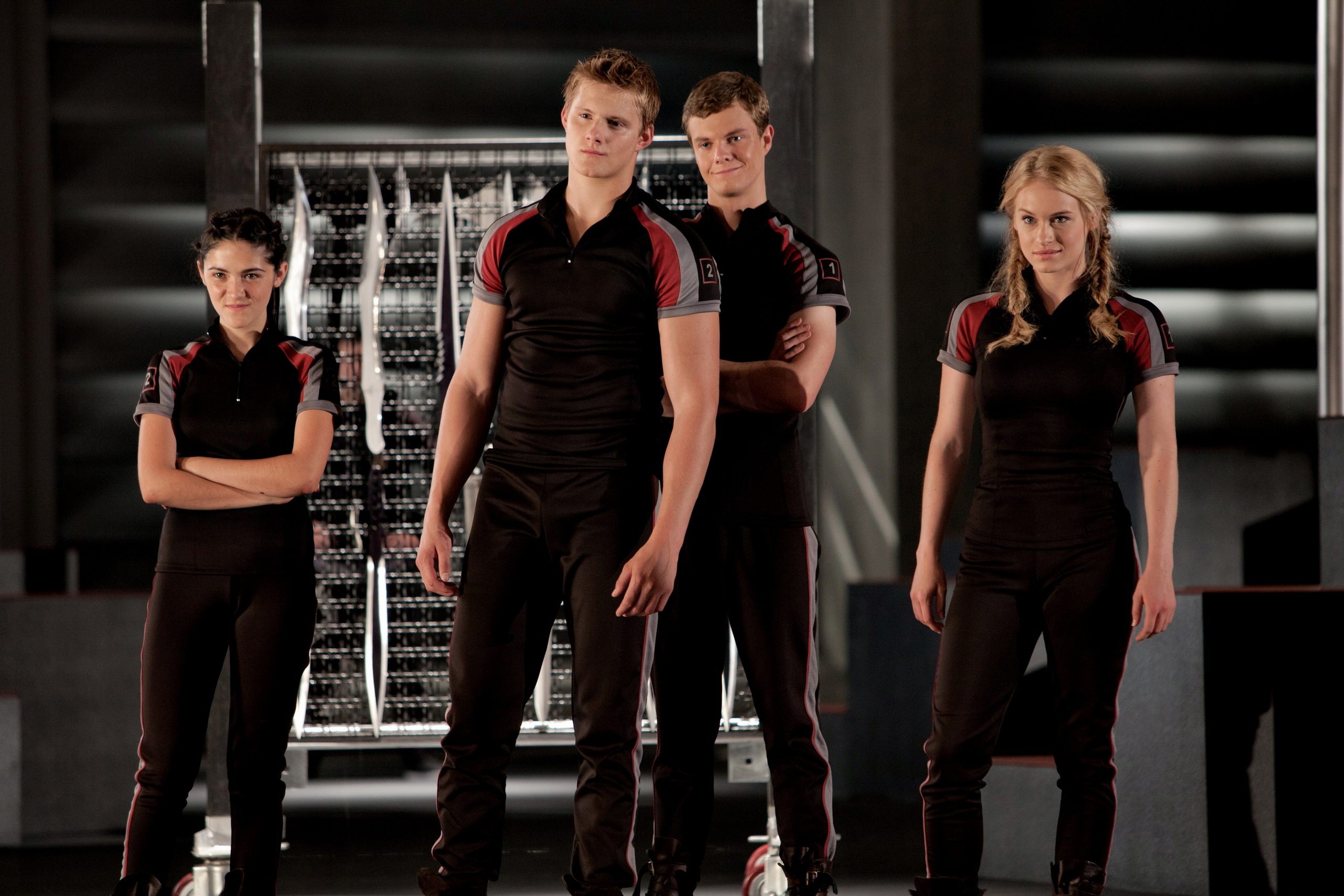
| Careers are so cocky. |
It’s no secret that The
Hunger Games is not a completely novel concept between criticism that the
story is an overrated Battle Royale
and the fact that killing for entertainment using those lower on the social
ladder can be traced back to the Roman Coliseum. That’s to say nothing of Lord of the Flies.
Consequently, one of the challenges going into the film was giving it a new
voice. Like the novel, that voice was
Katniss Everdeen, outstandingly played by Jennifer Lawrence. This is not just a story about kids being
forced to kill each other under an oppressive regime, this is Katniss’
story. It’s about a girl who, unlike
most of the other candidates, is not picked, but volunteers in order to save
her sister. The Hunger Games is not
fatalistic of humanity, showing its ugliness through the corruption of children
as in Battle Royale and Lord of the Flies. There was no way to run away or be saved. It was not shrouded in the mystery of the
wild or a private facility, but rather lauded and publicly performed as a
cultural tradition. The first
installment of the series is about how maintaining humanity in an inhumane
world can spark a rebellion.
2 2. First Person Limited
Ironically, overcoming the challenges of an arguably
overdone concept created an additional challenge. One of the great things about
the book was its first person limited point of view. We saw everything as Katniss saw it. Our view was her view. Her thoughts, and only hers, were ours. That kind of narrative is extremely
challenging to convert to film. Gary
Ross did his best. However, there were a
number of occasions where the film was still unable to do the book justice on
this front. Below, I highlight some of
the ways the film overcame these challenges, and some ways it fell short.
MERITS
1 1. Jennifer Lawrence, Jennifer Lawrence, and oh
yeah, Jennifer Lawrence.
| Let's just cast her in every movie ever from now on. Yes. |
Whether you’re a fan of the books or not, The Hunger Games
movie made one thing abundantly clear to those who weren’t already aware of it:
Jennifer Lawrence is a fantastic actress.
In many ways, she carried this film.
And in many ways, she was supposed to.
A first person limited narrative may have been one of the most difficult
challenges Gary Ross had to face, but it was a feat made possible largely due
to Lawrence’s performance. This is Katniss’
story, it makes sense that she would and should carry the film. I would go so far as to say had they cast
someone different, this film would have been an outright disaster. So kudos to you, Lawrence.
2 2. The Reaping Scene
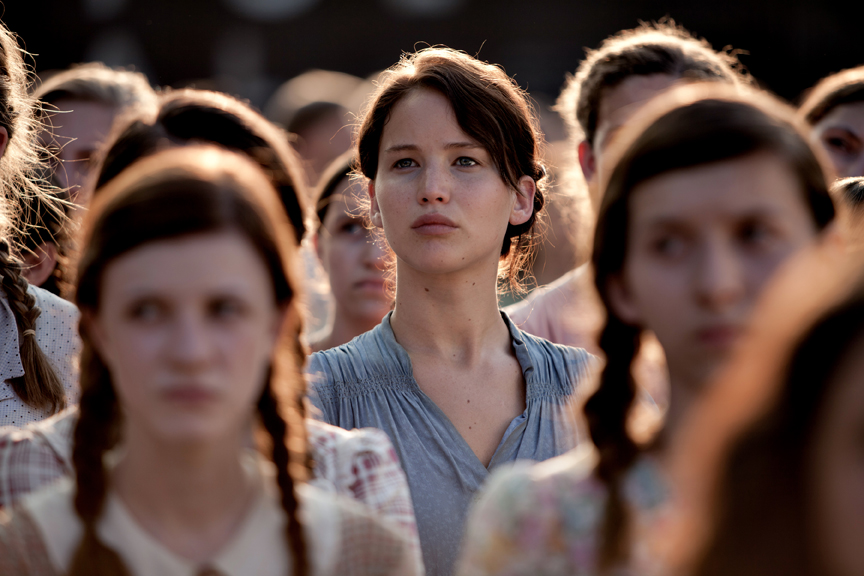
| The tension was palpable. So was the pink. |
This was done perfectly.
From little details like the way Prim, Katniss’ sister, tucks in the
back of her shirt before she prepares to walk up to the stage after her name is
called, to the heart wrenching moment when Katniss volunteers to take her
place. The thing that impressed me most
about this scene is how the previews did it absolutely no justice at all. I should point out that perhaps my bias, having read the book, sees more than what is communicated on screen. After all, the Reader has the benefit of understanding
exactly how this is affecting Katniss. I
imagine access into her thoughts give this film a depth that it may not have
alone. Still, I believe the reaping is
one of the view scenes where the gravity of the film matches the novel.
3 3. Rue’s
Death
| The simple pleasures of eating wild bird after you've been living on bark and jerky. |
Again, this scene was probably less devastating to those who had not read the book. In the novel Katniss spends much more time taking care of Rue, and narrating how much she reminds her of her sister Prim. The two form an alliance together and Rue tells Katniss about the agricultural district, giving some insight into the how others in Panem live. By the time Rue dies, the Reader has formed a bond vicariously through Katniss who has come to see Rue as another younger sister. In the film, Lawrence does a fantastic job communicating the agony of that loss and despairing at the injustice. However, to a Nonreader, it may have seemed like it was just a sad death of someone too young, rather than the death of a fleshed out character.
One addition the movie made to the book that improved the gravity
it might have lost in translation was depicting the rebellion initiated by Rue’s
death. In the book there are no cuts to
the outside world, or explanations by announcers. Only the mind of Katniss. Seeing how Rue’s district reacted to her
death gave the audience an opportunity to see how Katniss’ attitude, unbeknownst
to her, had begun to influence others.
This insight paves the way nicely for the second installment.
MISSED OPPORTUNITIES
1 1. An R rating
| No, Katniss. Shoot Marvel in the neck not the chest. It was bloodier and more awesome. |
Unfortunately, this is a young adult story with adult
violence. While I doubt it would have
hurt the film too much had they rated it R, from a business perspective it was
just not advisable. Still, I believe the
story lost some of its gravity by leaving out some choice gore. Take this excerpt of Katniss’ hallucinations
after she had been stung by tracker jackers:
“The world begins to bend in
alarming ways. A butterfly balloons into
the size of a house then shatters into a million stars. Trees transform to blood and splash down over
my boots. Ants begin to crawl out of the
blisters on my hands and I can’t shake them free…Someone’s screaming, a long
high pitched scream that never breaks for breath. I have a vague idea it might be me.”
Another example includes transplanting the dead tributes’
eyes onto the pack of dogs at the finale.
Somehow, a pack of large vicious dogs isn’t as eerie and terrifying as knowing
the Capitol had scooped out the dead children’s eyes and put them on dog
mutations just to terrorize the final survivors. Additionally, the end of the Games felt
slightly anti-climatic even to a Reader because the book version had Cato, the
main adversary, moaning and being tortured by the mutant dogs for hours: “It
takes a few moments to find Cato in the dim light, in the blood. Then the raw hunk of meat that used to be my
enemy makes a sound, and I know where his mouth is. And I think the word he’s trying to say is please.”
The lack of gore, and the sense that the movie was running
long may have contributed to the rushed ending.
It's unfortunate because a few more minutes could have made all the
difference. It took only a few sentences
in the book after the aircraft had picked the two up from the arena:
“I startle when I catch someone
staring at me from only a few inches away and then realize it’s my own face
reflecting back in the glass. Wild eyes,
hollow cheeks, my hair in a tangled mat.
Rabid. Feral. Mad…the next thing
I know we’ve landed back on the roof of the Training Center and they’re taking
Peeta but leaving me behind the door. I
start hurling myself against the glass, shrieking and I think I just catch a
glimpse of pink hair—it must be Effie, it has to be Effie coming to my rescue—when
a needle jabs me from behind.”
My biggest qualm about the movie was rushing the
ending. Even if you are making a sequel,
rushing the conclusion is never okay. To
me, skipping over the fact that one of the central characters loses his leg is
sort of a bad thing.
2 2. Secondary Character Depth
| "I think Cato has a crush on you. Go throw something heavy." |
While this is Katniss’ story, the film fell a little short
in developing some of the other characters.
Namely, Peeta and Haymitch. The
film didn’t do a great job conveying that Peeta was not faking his
sincerity. To Nonreaders, his expression
of horror at being called at the reaping was just a scared kid. To a Reader, his pained expression resulted
from knowing he was going to have to kill someone he’d loved his whole life if
he wanted to survive. However, it soon
becomes clear to the Reader that, from the beginning, Peeta knew he was going
to die, because he wanted Katniss to win.
All of his actions were oriented toward staying alive only long enough
to help her win.
Somehow the movie simultaneously
understated Peeta’s affection and overstated Katniss’. Katniss’ expressions of affection for Peeta
were almost all staged for survival in the first installment. As a result she assumed Peeta’s motives were
just as calculating. In the end, she was
told to fake her love for him because to do otherwise would put her family in
peril. In the novel, she asked why Peeta
wasn’t told to do the same and Haymitch replies, “He’s already there.” I don't believe Hutcherson was at fault, but this dynamic was missing from the movie, and
it’s something that would have given more depth to Peeta. As it is, he comes out a little flat.
| "Oh..shit." |
Another character that came up short, though slightly less
so, was Haymitch, the District 12 mentor.
However, this was more due to the film’s writing than any shortcoming of
Woody Harrelson, who did an admirable job.
Haymitch represented what happened to winners. They received a life of luxury in return for
being a victor, but that came at a price as well.
| Slouching is the new black. |
Haymitch is forced to mentor District 12
children, who have little to no chance of winning. Year after year, this man has to watch as the
kids he is supposed to be helping get slaughtered at his direction. It’s no wonder he had given up. Hopefully, Haymitch will be developed more in
the other installments.
FINAL THOUGHTS
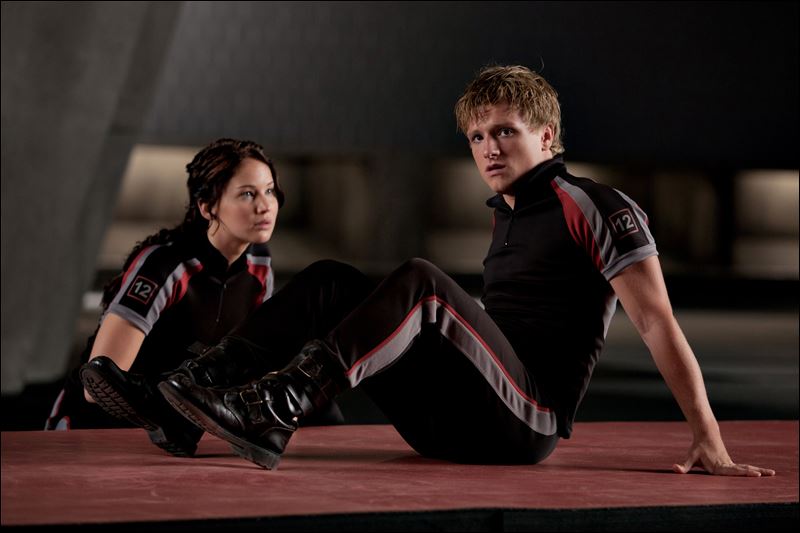
| "Look, fire is the new slouching. I don't make the rules" |
Though sometimes faltering in carrying the depth of the book, the running theme of
The Hunger Games movie is that it is factually faithful. However, the lines and logical leaps a
Nonreader would have to make to experience what a Reader sees is a bit too attenuated,
leaving those who have not read it in the dark as to some of the story’s finer
moments. Overall however, I have seen
much worse novel-to-film renditions. In
fact, this was one of the best I’ve ever seen.
Again, with the caveat that I am a Reader: 8.5/10 or A-
Friday, February 17, 2012
A DC State of Mind
![]() |
| The DC sky, working hard to make to moon look impressive. |
I’m fairly certain this is not news, but working on anything
is like pushing a dead car; once you get it going, it’s actually harder to stop
it abruptly than it is to keep it moving.
In the rare moments I actually find myself in this situation, I can’t
help but think, “This is what it must be like to have a type A personality.” To be successful in DC, a type A personality appears to be
an unsaid prerequisite. As literate binge
drinkers, DC seems to wear that designation like a badge of pride.
My law school career counselor once told me I have a
humility that, while charming, is a bit overdeveloped and could hurt me in
my career. To this, I had to resist the
urge to reply, “Well, maybe my humility is just right, and everyone else in
this city and profession is just a narcissist.”
But, even in my head, that sounded narcissistic, so I refrained. Though, I think the fact that I started a blog at all makes me narcissistic on some level.
Self-image aside, I really don’t know what it’s like to want or
need
to punish myself with work. Every time I
worked hard on something, I either did it after arguably unreasonable procrastination,
or I loved what I was doing. In the
latter case, concepts of time and effort disappeared altogether. Extrinsic motivation and competition for the
sake of it always seemed pointless. I’m
not intimating that that’s exactly a good thing. Sometimes extrinsic motivators like wealth,
prestige, or recognition of any kind is the only thing that gets us through
those rough days where we don’t get to do the things we love. You know how I get through them? Barely.
And with beer. Beer and video
games.
| My average day. But less cute. |
Never in my life have I felt as lazy and irresponsible as I
have in this city. Maybe that’s why I
love it so much. If I am the dumbest of
those around me, I don’t have to deal with dumb people. I think the wounded ego is a fair trade-off
for this benefit, and one I've grown accustomed to.
Cheers, DC.
Thursday, February 16, 2012
t'Gaverhopke Singing Blonde
| Eat your heart out, Gulden Draak. |
I had the pleasure of sampling this amazing Belgian ale on draft last weekend at Pizzeria Paradiso at Dupont. This tiny brewery, whose name and town I am incapable of pronouncing, made an ale that quickly jumped into my list of top three beers I've ever tasted. At almost 10% abv, it was astonishingly smooth and pleasantly sweet and dry. Beyond that, I'm not going to even pretend I know how to pull out complex flavors from beer. I'm definitely not a beer critic. I just know that it was amazing and absolutely worth a try if you can get your hands on some, especially if you're a fan of Belgian ales.
Pizzeria Paradiso's beer lists are more fickle than my resolve not to procrastinate and do some real work instead of writing this blog. So, it probably isn't on their menu anymore. But this was such a tasty one I had to see if I could find some bottles around DC. In my search, I ran into 12 Percent Imports, a distributor of imported ales. Their site lists about 10 major cities you can find restaurants and retailers who just might carry Singing Blonde, including DC.
The hunt begins!...Right after I attend Paradiso's Barlywine Bash this weekend. Gotta save my liver. More on that after the event.
Subscribe to:
Posts (Atom)